By Malcolm Ryder
Oakland Art Murmur today celebrates a remarkably distinct role in the East Bay’s life of the arts. In a climate that features dramatic cutbacks in schools, businesses, and longstanding non-profits, support of the arts finds high energy and community-based strength through the round-the-clock engagement efforts by Oakland Art Murmur, linking the public, venues, and artists to each other.
Looking back from 2006 to today, we see Oakland Art Murmur moving from being a grassroots gallery crawl to an impactful nonprofit organization, becoming the “steward” of the East Bay’s visual legacy and serving as the backbone of Oakland’s visual arts ecosystem.
2006 to 2013: Grassroots Beginnings
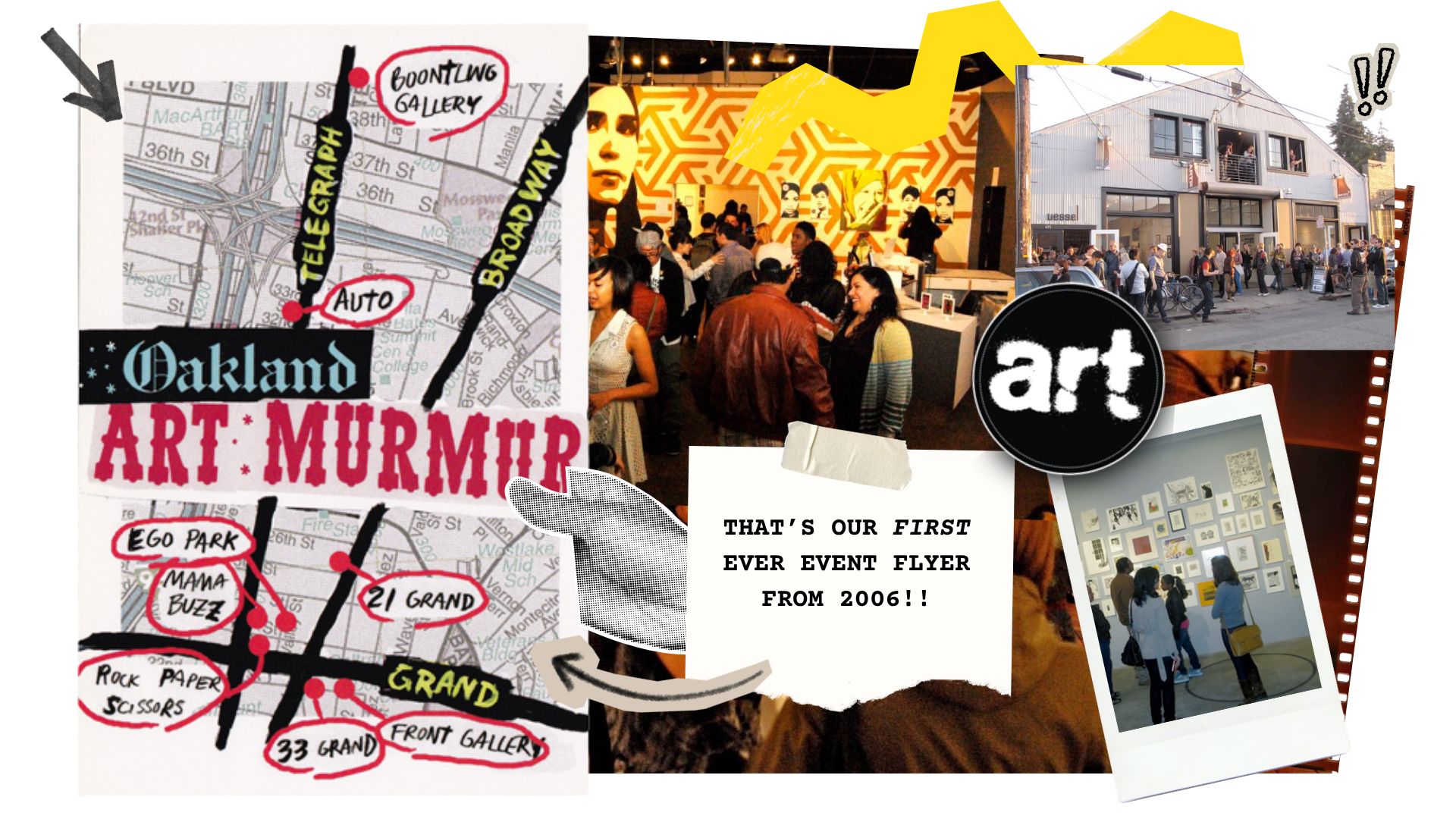
At its beginning, Oakland Art Murmur was less an “organization” and more of a shared “scene”, created by a volunteer-led collective of eight art spaces in Northgate and Temescal (including Rock Paper Scissors Collective and 21 Grand). This group coordinated the original “Art Murmur” First Friday Art Walk: a monthly opening night that turned the Northgate/Telegraph corridor into a cultural magnet. Galleries stayed open late on the first Friday of every month. This sidewalk-focused event quickly grew from a community gathering to one attracting thousands through word-of-mouth.
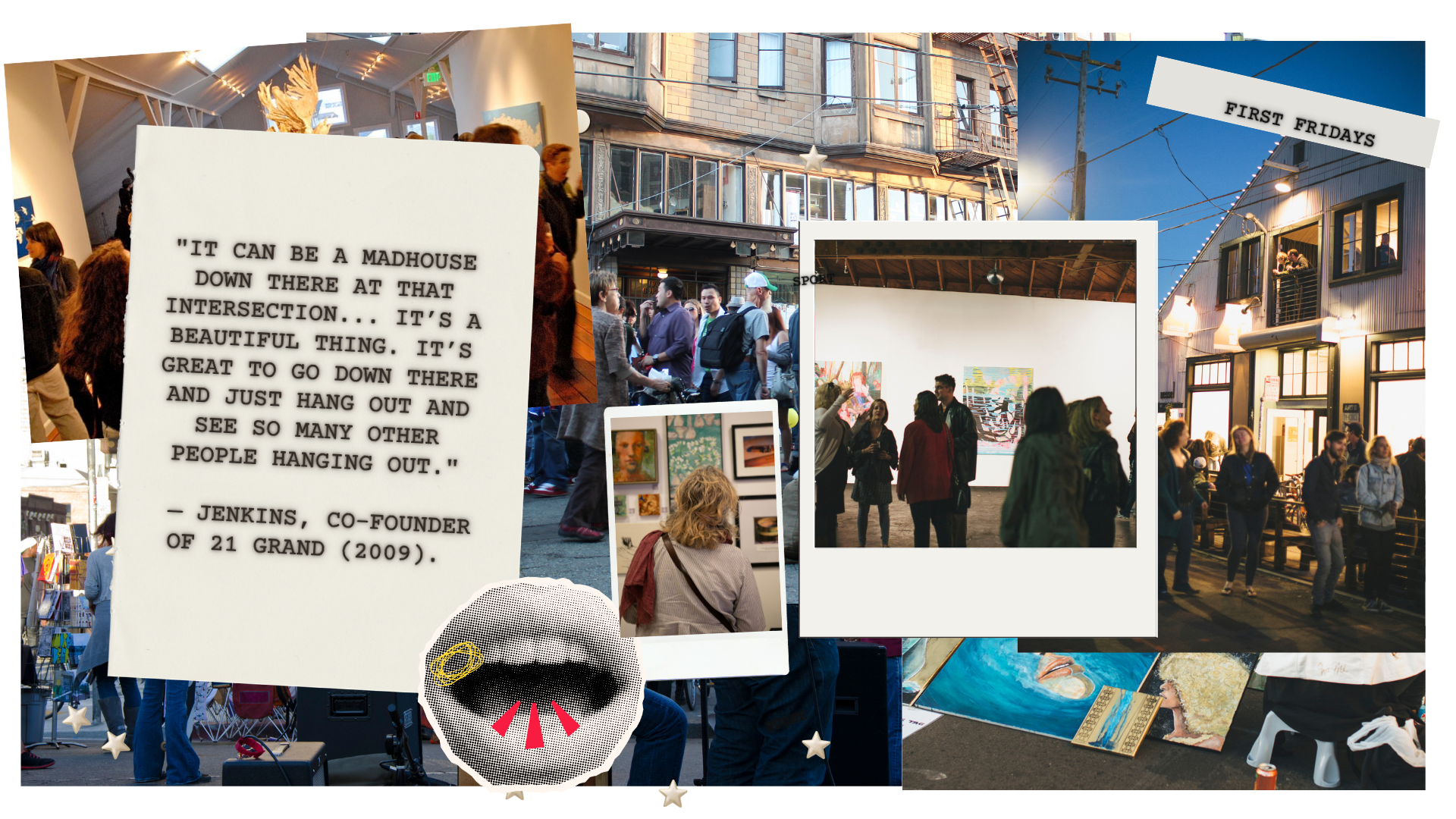
“It can be a madhouse down there at that intersection… It’s a beautiful thing. It’s great to go down there and just hang out and see so many other people hanging out.” — Jenkins, co-founder of 21 Grand (2009).
Of course, this included artists from all over as well, with an excellent opportunity to compare and collaborate among the works on view.
“I’m really interested in the idea that, when you put a couple of images next to each other, your brain will make a story to justify them being together… gallery-walkers will enjoy trying to piece [her] puzzles together.” — Ottinger, early Oakland Art Murmur exhibiting artist.
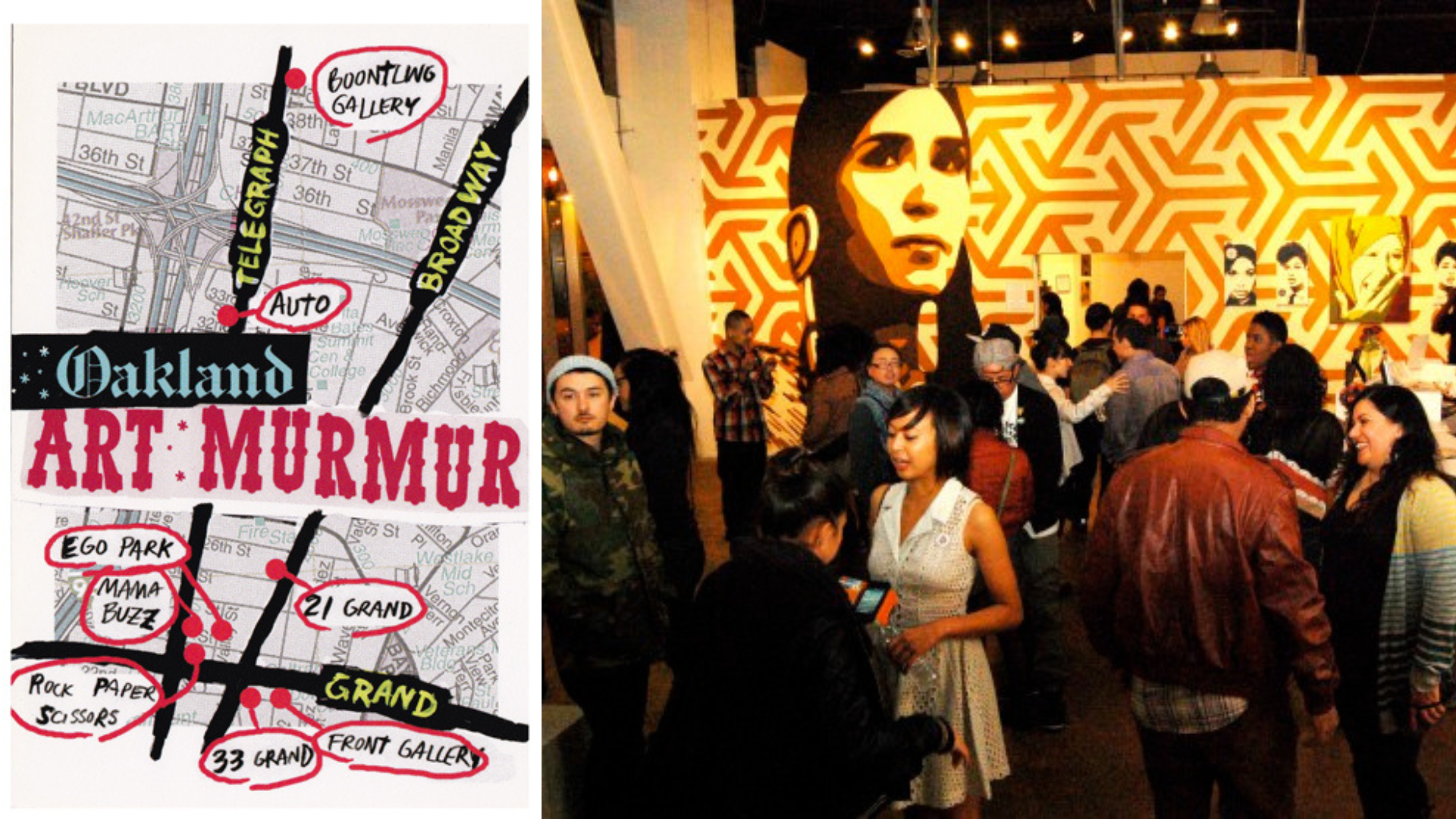
Oakland Art Murmur began to print maps guiding all visitors to the venues, graphically announcing the transformation of a Northgate/Telegraph corridor into a virtual cultural zone. This visibility stimulated expanded gallery participation that embraced more unusual or hidden venues as well.
By 2010, Oakland Art Murmur had become a formal 501c3 nonprofit. But the scale of the event, now a massive street festival, became increasingly unmanageable by the Oakland Art Murmur collective…
“The event has reached a critical juncture, where the obligation to consider these things [trash, safety, traffic] may determine the fate of the event.” — Oakland North (2012).
… and in 2012, seeking to protect the “art” within the “party,” Oakland Art Murmur officially handed the event management of the First Friday street festival over to the KONO (Koreatown Northgate) district**. This pivotal strategic move allowed Oakland Art Murmur to refocus on its core mission: supporting the galleries and the artists.
“What we do inside the gallery spaces is Art Murmur. What happens out in the street is First Friday.” — Danielle Fox, former Oakland Art Murmur Director (2012).
Making this focus more explicit, Oakland Art Murmur instituted the Saturday Stroll, for those who found the Friday crowds overwhelming, also as most gallery hours are open on Saturdays. As a new organized experience, this was a critical move that immediately gained wide appreciation, although the public largely continued to think of First Fridays and Art Murmur as being synonymous…
“A quieter and more focused time to view art and visit with gallery directors… a low-key alternative to Art Murmur and the throngs it attracts.” — Erica Skone-Rees, local organizer and boutique owner.
2014 to 2019: Part of the Larger Arts Ecosystem
The focus also triggered Oakland Art Murmur’s expansion during 2014 to 2019 through engaging more of the area’s overall arts ecosystem. It began tackling the economy of the arts through Professional Development workshops that took on the “starving artist” myth with practical business logic, covering topics like pricing, portfolio building, and gallery representation.
“Putting monetary value on your art can be a very triggering process… we use guidelines that can make this process more systematic, consistent, and less daunting.” — Martha Zlatar, Artist Success Coach.
Additionally, the programming moved online with a comprehensive directory of art spaces, becoming a year-round resource rather than just a monthly event promoter.
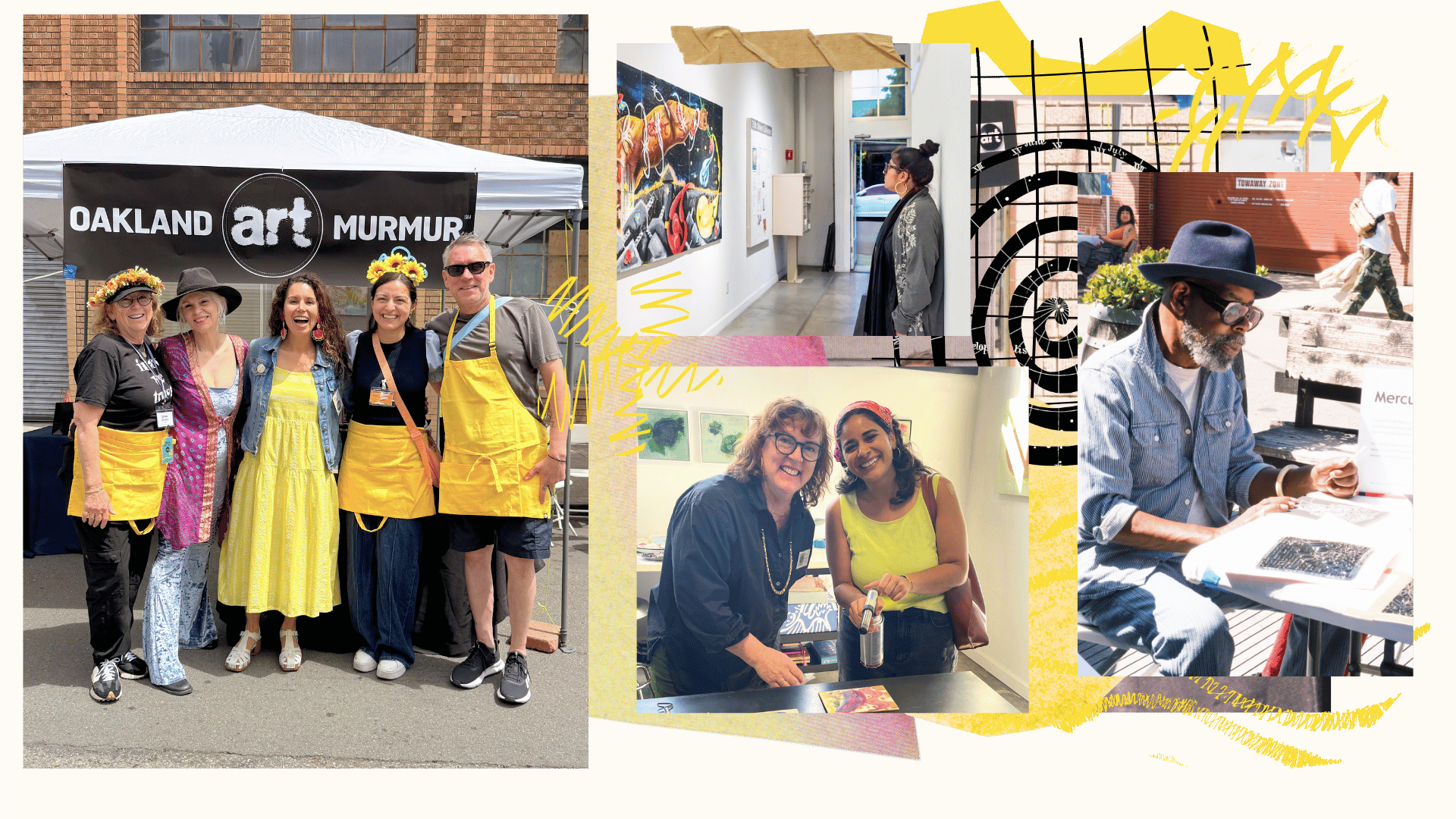
2020 to 2024: Expanding Impactful Programming
As Oakland Art Murmur matured into a stable, ongoing resource for the arts community, it also became more deeply entangled with the forces shaping that community’s survival. The East Bay region’s arts ecosystem had always been the backdrop of Oakland Art Murmur’s evolution. Centered in Oakland, the arts community was throughout that time extremely sensitive to, and affected by, enormous pressures in real estate markets, social strife, and political responses to natural or “manmade” disasters.
Most historians of the region agree that housing, wealth, and social justice issues triggered events that are milestones in the shifting trail of support for the arts. One of the most prominent and recurring issues is that of artists rehabilitating neighborhoods to a level of desirability that instigates their being priced out and unable to stay there. The disastrous Ghost Ship fire forced legal changes in how property could be used by artists. And of course, in 2020 the double blow of COVID and George Floyd’s death shut down most ordinary art gatherings, at the same time that it provoked an unprecedented intensity of artistic expression in protests.
Oakland Art Murmur’s response to this was to absorb other historic programs to ensure their survival.
- Art for the Movement (2020): In response to the local 2020 racial inequality protests, Oakland Art Murmur collaborated with Black Cultural Zone to document and preserve the protest murals created on storefronts across the city. Oakland Art Murmur helped transform grief into a public archive of murals.
“I have never seen Downtown Oakland this beautiful!!!… These artworks are artifacts of a social justice movement and carry with them important stories and context.” — Justin Hughes, community member and investor (2020).
- Mural Tours: In partnership with the Bay Area Mural Program (BAMP), Oakland Art Murmur offered curated guided tours focusing on Oakland’s world-class public street art. Oakland Art Murmur’s tours became a top recommendation for exploring Oakland’s “hidden” identity.
“Each mural and sculpture revealed hidden gems of this city’s culture… it’s a date idea that mixes culture with exploration.” — Olivia Turner, local explorer and reviewer (2025).
- Art About Town: In 2020 Oakland Art Murmur had launched Art About Town, a monthly writeup about the area’s visual arts featuring interviews, reviews, and spotlight articles to give Oakland artists wider exposure beyond the physical gallery walls.
- East Bay Open Studios (EBOS): In 2023, Oakland Art Murmur took over the management/promotion of this massive, multi-city program across Alameda and Contra Costa counties. It is now Oakland Art Murmur’s largest annual event, creating direct connections between the public and artists at their studios and workspaces, a dramatic expansion of coverage augmenting galleries and venues.
“Sharing is what makes us human… its importance in the mission is that it finds us – it takes us in when we need to be with other people.” — Ebrahim Leri, Art About Town contributor.
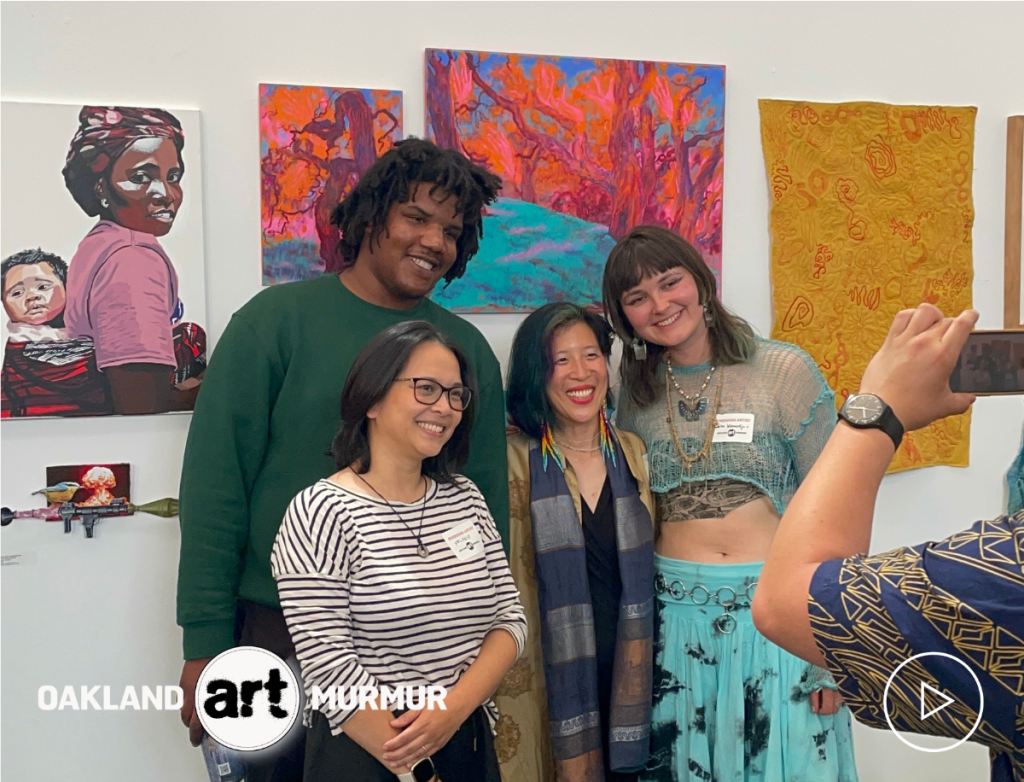
Now: Visions for the Future
Operating under a broader strategic vision and a set of organizational goals, Oakland Art Murmur’s official mission statement is:
“To support and promote visual artists and arts venues, and to connect the public to the vibrant and eclectic art of the East Bay.” With that connection, “Oakland Art Murmur envisions an East Bay where visual culture thrives and where artists and art venues are both sustained through arts-based economic vitality.”
With Oakland often cited* both as one of the most diverse US cities and having one of the highest concentrations of artists, reports also show that 69% of the East Bay’s artists have lived in their current county for more than ten years, with Oakland serving as a primary hub for this stable creative population.
Still, most of the region’s arts community is busy adjusting to recent heavy cutbacks in financial support of the arts from the federal on down to the local level. Moreover, as of 2025, an estimated 85% of the artists Oakland Art Murmur serves are low income. Given the various and ongoing economic pressures on artists, it is all the more relevant that Oakland Art Murmur’s own development over time has brought it to its current mission. Oakland Art Murmur tackled this head on in 2025 by introducing the Emerging Artist Program: a mentorship initiative designed to uplift early-career artists from historically underserved backgrounds, providing them with exhibition space and professional guidance.
Oakland Art Murmur’s most recent Impact Statement*** also shows the community is showing steadily increasing confidence in Oakland Art Murmur’s ability to be the most effective “meeting place” of the key players across the arts ecosystem for advancing each other’s interests.
That role starts, as it always has, on First Friday, which still happens twelve months a year. We proudly partner with the organizers of the First Friday Street Fair, each contributing to a uniquely Oakland celebration of creativity that brings together galleries, artists, and the community. But you don’t have to wait until First Friday. Throughout the month, Oakland Art Murmur features exhibitions, artist talks, special events, and other opportunities to connect with the vibrant visual arts community across the East Bay. We believe art has the power to build community, spark conversation, and strengthen our local creative economy year-round. Explore what’s happening at oaklandartmurmur.org/events or follow @oaklandartmurmur on social media to stay connected.
– M. Ryder, Oakland Art Murmur
* Oakland CA 2026 Stats
| Feature | Primary Source | Current Status |
|---|---|---|
| Diversity | WalletHub / US Census | Consistently Top 10 in Overall & Ethnoracial Diversity |
| Artist Concentration | NEA / US Census Bureau | Top 1-2 per capita for working artists in the U.S. |
| Cultural Density | Metris Arts / City of Oakland | Top quintile for arts organizations and public spending |
** KONO, short for Koreatown Northgate, is a vibrant, diverse neighborhood and Community Benefit District in Oakland, CA, centered along Telegraph Avenue between 20th and 35th Streets. A Community Benefit District (CBD) in Oakland is a specific, geographically defined neighborhood where property owners vote to pay a special assessment (tax) to fund improvements above and beyond city services. Launched in 2008, its purpose is to revitalize areas, increase safety, and support business growth.
*** Arts Impact: See the report here: https://oaklandartmurmur.org/impact-report/
— Malcolm Ryder
________________________________________________________________
Malcolm Ryder is an Oakland-based photographer and Bay Area art critic, publishing frequently at Art About Town and Artdotdot.com. The designer and former manager of the Visual Artists Fellowships Grants process at the National Endowment for the Arts, he currently sits on the Boards of Oakland Art Murmur and the East Bay Photo Collective. His work is on exhibit at several satellite galleries in this year’s African Diaspora event.
All images above are excerpts of individual works by the respectively credited artists. Copyrights are reserved by the artists.